

For the past three decades, the banana has become the fruit equivalent of beige. It’s ever-present. You buy it because it’s there, and then you eat it because it’s… there. It’s not really craveable, and it’s not been at the forefront of anyone’s thoughts, really.
And yet, bananas are the highest-selling and most-produced fruit, reaching over 139 million metric tons annually. Watermelons are trailing behind at around 104 million metric tons annually. It’s not that I’m a banana hater; it’s just that I believe that their abundance and ubiquity in fruit bowls across the globe have led to a lack of attention.
If they’re always available, always present, always there, then what gives them an edge of interest?
But when Prada puts its logo on banana candy, and Sabrina Carpenter eats them on camera, there’s intrigue. When Starbucks fuses banana cream with matcha and protein cold foam into a drink, bananas further entrench themselves into the zeitgeist. And when Rhode builds lip treatments around the flavor profile of a caramelized one, banana inevitably tips into an obsession.
Banana is trending, right now, but to be clear, not in the way sardines took over last summer. This one is more interesting, and it starts, strangely, with the fact that bananas now might be in trouble.
In July 2025, Fresh Del Monte Produce’s CEO issued what the industry called a “stark warning” of an “oncoming banana crisis,” pointing to the spread of Black Sigatoka fungus and TR4 disease, which are driving an imbalance between global supply and demand. Costa Rica, one of the world’s largest exporters, watched its 2025 harvest fall 23%, losing roughly 12.4 million banana boxes to disease, erratic weather, and rising input costs.
The conventional trend logic holds that abundance enables adoption. Guava, for example, went mainstream as tropical supply chains opened, and matcha exploded when Japanese tea became globally accessible.
But bananas are trending while simultaneously becoming harder and more expensive to grow. When a flavor trends against supply rather than with it, what you’re looking at is desire untethered from convenience, and I think that’s a far more interesting trend than one driven by a glut of cheap raw material.
As we all know, scarcity tends to deepen cultural attachment rather than kill it.
To take bananas seriously as a cultural movement, you have to understand why it hasn’t been taken seriously for so long. Artificial banana flavoring has existed in the United States since the 1850s, predating widespread access to the actual fruit. Flavor historian Nadia Berenstein has traced the first formulas to the 1860s, when banana essences appeared in hard candies and puddings for consumers who had never tasted a fresh one. The isoamyl acetate compound that gives Runts, Laffy Taffy, and circus peanuts their distinctive quality is its own thing, equally craveable to millions of people who grew up with it.
What makes this stranger is that the real banana has also changed. In the early 1900s, the dominant commercial variety was the Gros Michel. It was fatter, sweeter, and so heavily loaded with isoamyl acetate that it actually resembled the artificial flavoring. But a fungus wiped it out in the 1950s, and the Cavendish replaced it. It’s the blander, milder fruit that we know now. In other words, the candy version and the real version used to share the same flavor.
But what this means now is that a banana carries two separate flavor memories simultaneously. There’s the childhood-candy register that’s synthetic and almost perfumey, and there’s the fresh-fruit one that’s mild, creamy, and slightly floral. Most fruits, or ingredients, only get one. Banana gets both, which gives brands an unusual amount of creative latitude.
You can go nostalgic, sophisticated, candy-coded, or ingredient-forward, and you’re still within the same coherent cultural universe. It’s rarer than it sounds; not many foods share this.
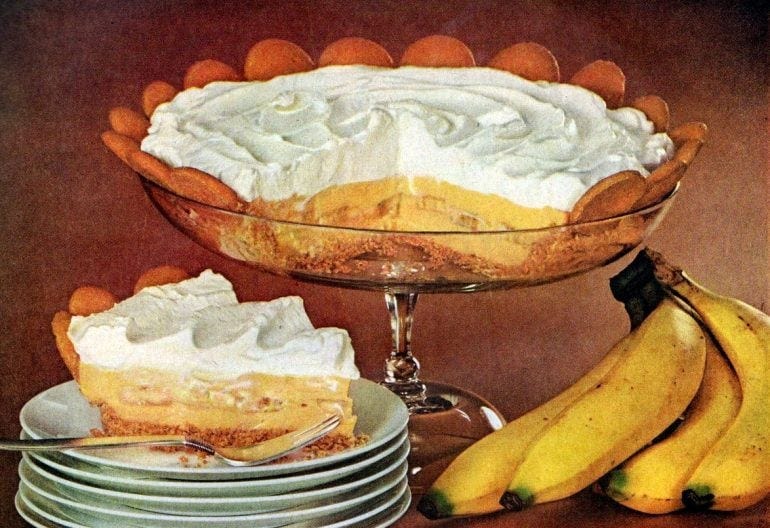
The last time bananas were genuinely “hot” was mid-century America, and it was the kind built on novelty and postwar abundance. The banana split, invented around 1904 in Latrobe, Pennsylvania, became an ice cream shop and soda fountain staple by the 1950s. It was a theatrical dessert. Banana cream pie and banana pudding followed the same logic. Bananas Foster, invented at Brennan’s in New Orleans in 1951, was literally set on fire tableside. These desserts were meant to bring the drama.
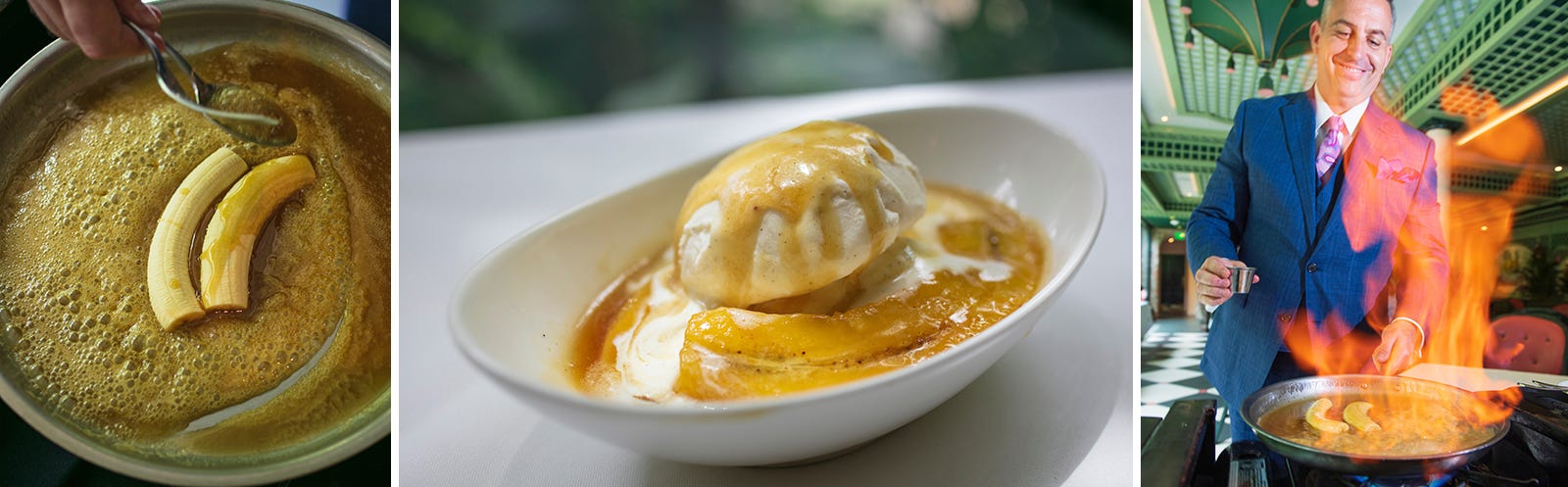
Somewhere in the 1970s and 80s, that drama puttered out. The banana split became a kids’ menu special, and banana pudding moved into plastic cups. Familiarity bred invisibility. Although I have had the Bananas Foster at Brennan’s, the magic is very much still alive there.
We’ve seen brief revivals. When Magnolia Bakery opened in New York’s West Village in 1996 and eventually went national, its banana pudding became something of a phenomenon. People lined up for it, which, in retrospect, was an early signal that banana nostalgia had real commercial power when executed intentionally. But Magnolia was selling comfort and Americana as much as it was selling banana, and the ingredient itself didn’t travel much beyond that moment. Although the JKR rebrand seemingly didn’t seem to propel the brand too far into the cultural zeitgeist beyond the design work itself, they are scheduled to open nine U.S. shops in 2026 alone, all driven by franchising.
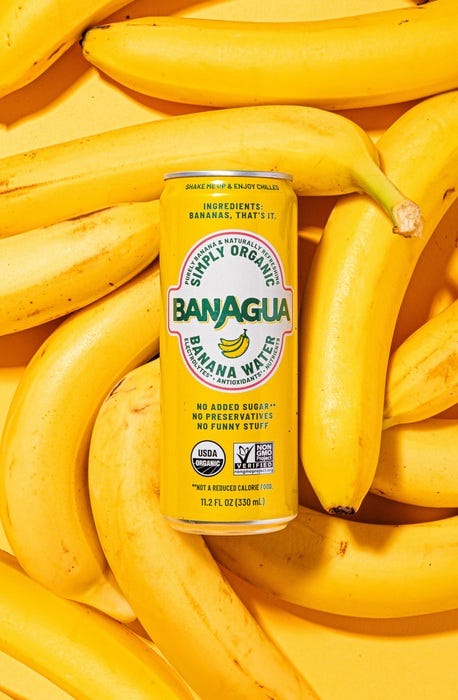
But, recently, Banagua, which has just secured $5.5 million from Hingham Growth Partners and expanded into more than 3,500 retail doors, including Sprouts, Albertsons, Kroger, and Erewhon, is explicitly positioning itself as interesting, following in the footsteps of coconut water. Co-founder Rob Smithson has said that he believes banana water is where coconut water was twenty years ago.
Vita Coco launched in 2004 as a specialty health-store curiosity. Celebrity investors like Madonna and Matthew McConaughey arrived by 2009. A national distribution deal with Keurig Dr. Pepper followed in 2010. By the mid-2020s, Vita Coco held roughly 50% of the U.S. branded coconut water market. But it took the better part of a decade.
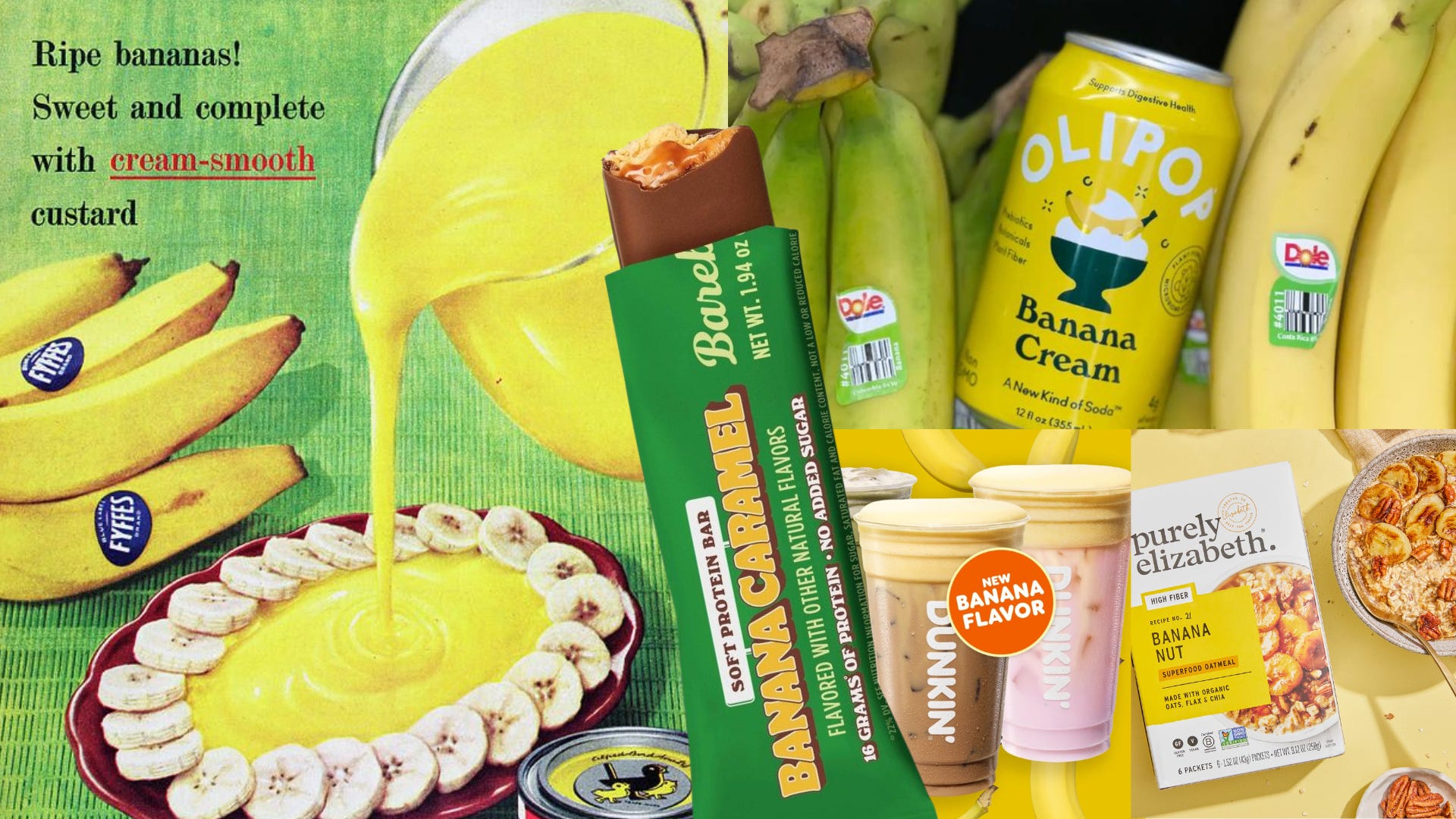
Dunkin’s spring 2026 lineup leaned into banana hard, with a full suite of drinks built around banana syrup and banana cold foam. The Banana Puddin’ Cloud Latte, the Bananarama Matcha, Chocolate Covered Banana Iced Coffee, Banana Protein Latte, and Banana Daydream Refreshers.
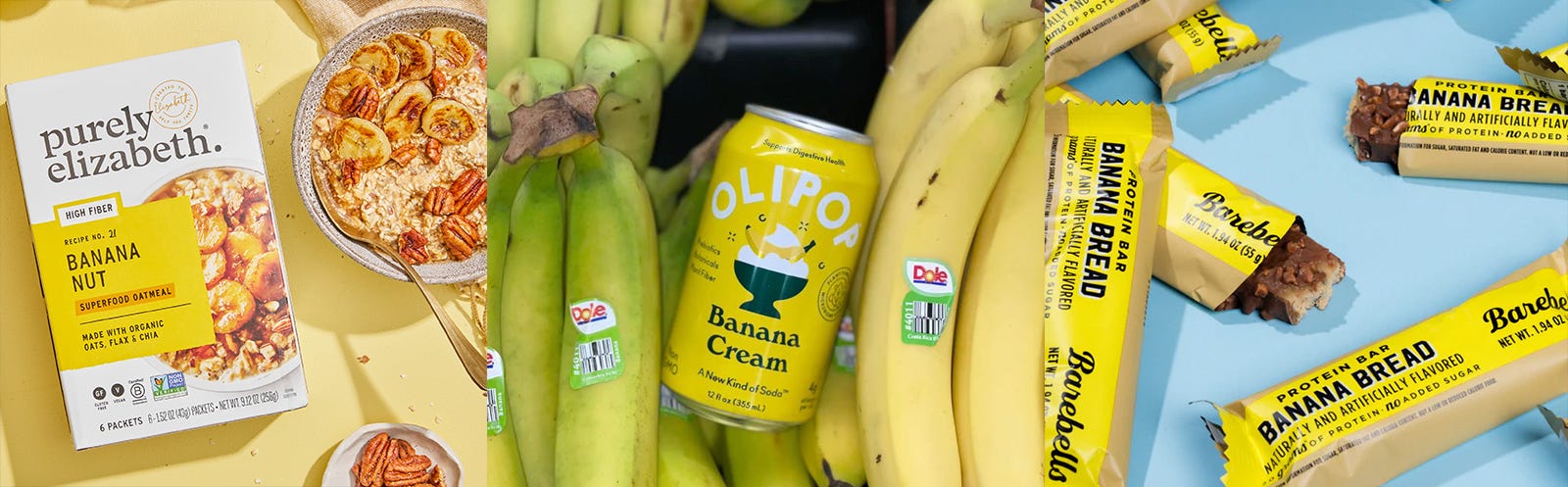
Let us not forget that OLIPOP has banana cream as one of its flavors. Glossier’s Banana Pudding Balm Dotcom, launched in collaboration with Magnolia Bakery last summer, as did Purely Elizabeth’s cinnamon chip banana bread flavor protein granola. Then Little Debbie issued a Banana Puddin’ Creme Pie last January. And three weeks ago, Barebells launched a Banana Bread protein bar.
Part of what makes banana a durable ingredient trend is that it can earn its place across categories and not just be used for aesthetic purposes, unlike guava, for example. In skincare, banana peel contains natural AHAs and potassium; there’s real science that gives the ingredient credibility. In fragrance, banana flower rather than ripe banana unlocks a greener, more complex register. In food and beverage, bananas’ natural sweetness is functionally useful, helping brands reduce added sugar, which matters enormously in a regulatory and cultural environment increasingly hostile to dependence on sweeteners.
Fermented banana formats like banana vinegar or banana miso are intriguing on paper, but still extremely niche. Banana’s familiarity, which is its greatest asset, can also be a creative ceiling. Consumers come to banana with strong expectations, unlike with rarer items like yuzu.
Starbucks’ Iced Banana Cream Protein Matcha is also a significant signal. It’s not a seasonal, limited-time offer, and it’s framed as having 24 grams of protein, with banana protein cold foam layered over unsweetened matcha. It’s hitting three distinct consumer trends simultaneously, including the protein obsession, the love of matcha, and, now, banana. It’s scale validation.
The protein point also matters beyond Starbucks. There’s space for bananas to become the next functional food carrier. Its natural creaminess makes it an ideal base for high-protein formats like shakes, bars, and yogurts that don’t have a chalky aftertaste. Banana is a great solution to the taste-function tradeoff that defines the category right now.
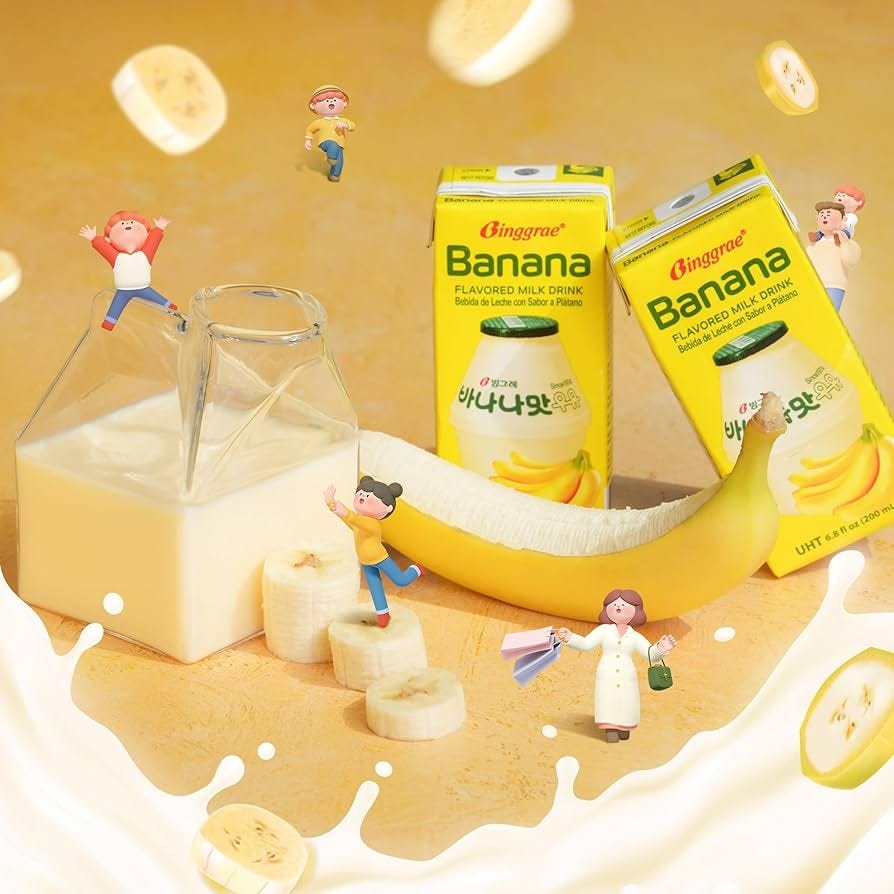
Then there’s banana milk, which is not what most people are thinking about right now. The global banana milk market was valued at $53.4 million in 2025 and is projected to reach $87.8 million by 2035. In the U.S., demand is expected to grow from $18.2 million to $29.2 million over the same period. It’s not oat milk numbers, but it’s also not a nothingburger (or perhaps a nothing banana?), and what’s more telling than the size is the direction.
Haircare, too, is underpenetrated in a way that feels almost inexplicable given banana’s DIY conditioning reputation. No prestige brand has built a coherent banana-anchored haircare franchise. And alcohol is barely in the conversation: banana daiquiris and bananas foster have deep cultural roots, but a sophisticated ready-to-drink version hasn’t arrived at scale.
Obviously, slapping a banana on a label because it’s trending won’t work in a vacuum. But building products and strategies around what banana actually does well, like its creaminess, natural sweetness, functional compatibility with protein and plant-based formats, and its ability to feel both elevated and approachable simultaneously, will create competitive advantages.
As we know, everything is cyclical, and banana splits are likely soon to swap from the kids’ menu back to the main one.
Until next week,
A bunch of wonderful insights!🍌