

There’s an economic theory that the middle is vanishing. It kind of sounds like it should be a metaphor, until you realize it’s actually true. The middle class, the mid-priced restaurant, the mid-range hotel, all of it slipping quietly into extinction. Pew Research has been charting this for decades. In 1971, 61 percent of Americans lived in middle-class households, but by 2023, that number had eroded to 51 percent, with the runoff pooling at both ends of the income spectrum. Consumers and capital cluster at the extremes.
I have spent months, years, really, listening to founders and designers, and I’m convinced the same comically long barbell has formed in design. The tiny studios seem fine, always scrappy, but fine. The giants are doing great.
It’s everyone in between wondering where the work went.
At the small end, the logic is almost sweet in its simplicity. Solo designers and micro-studios thrive on startup budgets. It’s the five-to-ten-thousand-dollar rebrand, turned around fast, with little to no strategy phase. Low stakes for everyone involved. These studios will never run out of work. For as long as you and I exist, there will always be a new founder with a Shopify store and a logo that needs designing.
At the other end sit the household names. Think Pentagram, JKR, Turner Duckworth, Red Antler. Their gravitational pull comes partly from the work and partly from, well, risk insurance. One independent studio founder told me about losing a project midstream when the client hired a marketing lead from a big corporate background. The new hire on the brand side had never heard of the studio, got nervous, and moved the work to the agency she’d used at her last job.
Still, when a brand wants to work with an agency, there’s seemingly no rulebook for this massive decision, no informed taste of its own. They outsource the judgment to their investors, their PR people, their board. And those tastemakers all mostly carry the same mental list of five agencies. If you’re not on the list, you’re asking a client to take a leap of faith with one of the biggest line items of their year.
“Pentagram’s not right for everybody, but because it’s such a big decision, I think [founders] feel the pressure to listen to their investors or go to a place that has cachet,” Allison Henry Aver, founder and creative director of Letter A, shares with me.
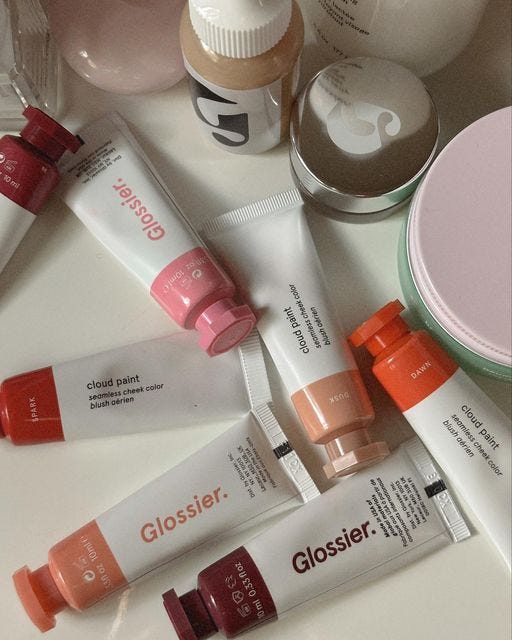
Not to mention, some agencies simply carry more clout than others because of their past clients, even when that past work looks nothing like what the brand actually needs. Henry Aver notes, “[Founders] often can’t tell one agency aesthetic from another; all the work looks the same to most. So, they’re just like, ‘Great, you did Glossier, must be good enough for me.’”
But consider the brand that’s outgrown its “starter-pack” branding, wants to level up for retail, and can actually afford a fifty-to-one-hundred-fifty-thousand-dollar engagement. Once upon a time, this was the bread and butter. Today, the agency founders I spoke with who serve that tier described landing maybe one such client per year, often as somebody’s second choice, from brands that went to the major players, got handed off to the junior varsity team, felt like a small fish, and came back wanting something personal.
“Finding the Venn diagram of brands that can afford this middle range is like a needle in a haystack,” shares Henry Aver.
Renata Costa, partner and global director at Tátil Design, who works with CPG brands like Coca‑Cola, Kimberly-Clark, and P&G, shares, “We are experiencing a clear reduction in retainers and projects driven purely by brand awareness. More and more, branding investments are expected to connect directly to business performance, sales, and conversion.”
Rollout and adaptation work is migrating in-house. According to the Association of National Advertisers, 82 percent of its member marketers now operate an in-house agency, up from just 42 percent in 2008, and nearly two-thirds have pulled work in-house that an external agency used to handle. Not to mention, AI is compressing production timelines. External agencies are increasingly reserved for the high-value problems only.
“You can sense budget anxiety when clients ask to break up structured design processes into bite-sized, fragmented tasks. It’s not that companies don’t value good design anymore; they’re just under heavy pressure to see quick, incremental returns. Yet they still expect speed, bulletproof scalability, and market impact,” mentions Costa.
Richard Brandon Taylor, founder and CEO at Brandon, shares similar thoughts. “Traditional branding projects used to follow a relatively simple cadence over 90-150 day programs. What we’re seeing now is a ‘stage-by-stage’ commitment with delays from concept through final design. The global geopolitical landscape we live in means every cent is accounted for, and client partners are having to jump through multiple hoops at every stage internally. Research after the Tropicana rebrand debacle is not being used to shape the direction of creativity, but to either kill it or give it the green light. It’s now a quant game and not qual.”
The team at VideoMatic, which built its entire studio around the intersection of science and storytelling, told me specialization, not raw demand, is what keeps them busy. When you’re the obvious choice for a narrow, high-stakes category, nobody questions the price. They’re comfortable enough to turn down work outside their craft, and they’re winning projects that once went to broader creative agencies, because clients increasingly want a partner who already speaks their language. Notably, they’d never want to be a mid-size agency.

Jonathan Roorda, head of design at VideoMatic, tells me, “At that point, I think you start to lose a certain level of flexibility, and there are simply more layers within the organization and more stakeholders involved. The balance between running the business and maintaining a high level of creative output becomes more challenging, while the scale of projects doesn’t necessarily increase at the same pace. I have a lot of respect for agencies that reach that size. It’s a huge responsibility with a lot of people depending on you.”
Meet The Edge’s Founder, Grant Plotkin, feels similarly: “Headcount = headache. 20+ people. Not for us.”
“Multinational client partners are moving away from that model and not committing to retained fees, instead moving to project-to-project budgets without a clear roadmap of just what is coming down the line, more of an overview that there will be work, but no guarantees. That lack of predictability is leading agencies to stall headcount and use freelance ninja talent for flexibility in good times. I see smaller, agile teams with flex to be the new agency model moving forward,” notes Taylor.
Here is the conclusion I keep arriving at: no matter which door I walk through, the middle-tier agency is disappearing because the people making recommendations only know, say, five names, and the brands taking those recommendations can’t tell great work from good-enough work. The market is punishing anonymity, which is definitely fixable.
Until the tastemakers’ list gets longer, the smartest agencies in the middle will keep doing the three things that actually move the needle. One: getting specific, and two: getting in the room with the money. The middle is only dying because decision-makers need a broader perspective on who “the best” agency is.
I guess in some ways, it all goes back to the taste economy.
interesting article!
Over on my Substack I talk about antiques, design and culture so you might find something that interests you! I’d LOVE to chat and connect!😊